Illustrated Tales
The Two Queens
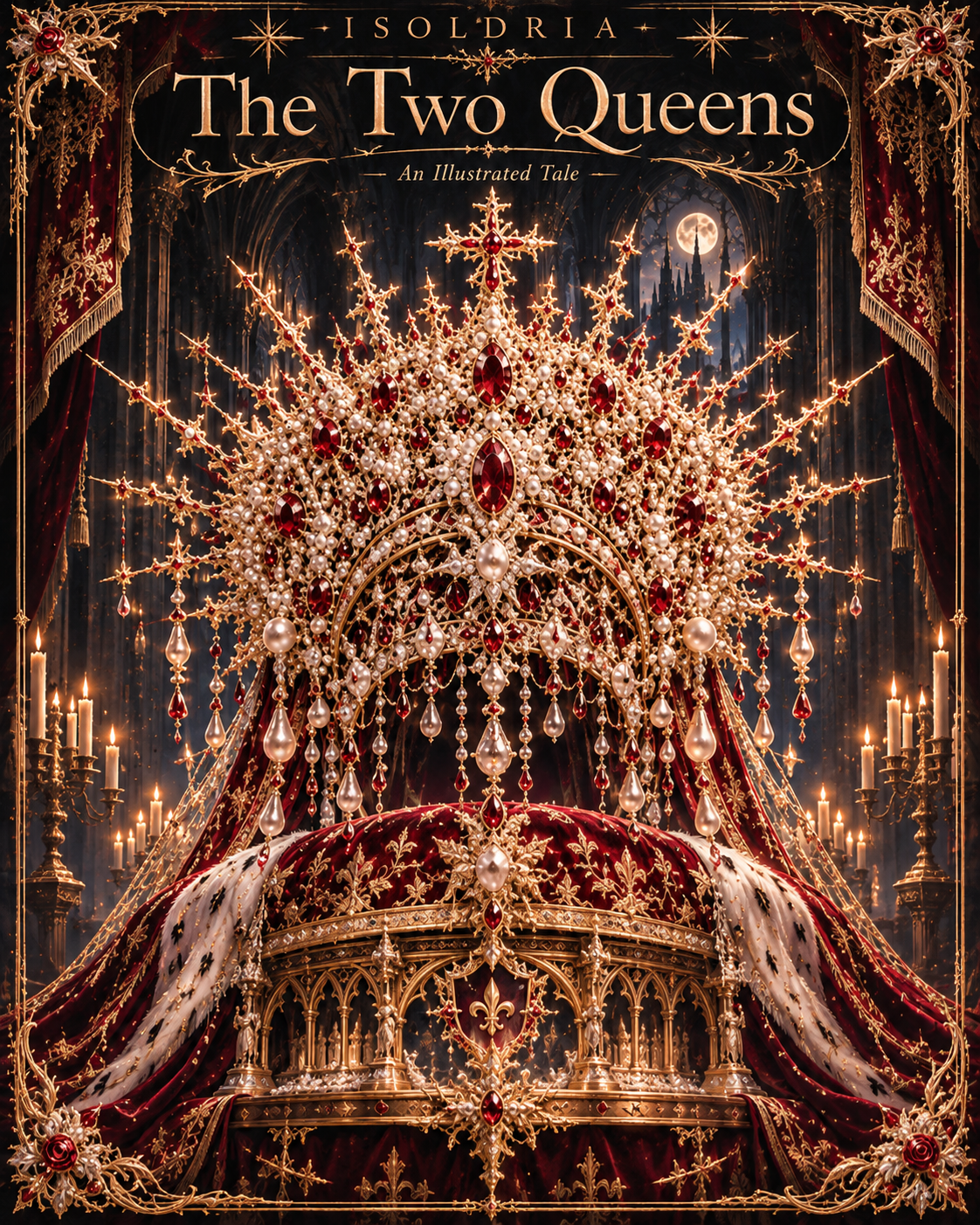
Long, long ago, there was an ancient kingdom.
In that kingdom was a crown of extraordinary beauty.
It was said to be a gift left behind by the gods. It was made of gold and pearls and gemstones whose names no one could remember, and it was older than the palace itself.
The people believed that the crown would forever rest upon the head of a king or queen, and so keep the kingdom safe.

One year, a terrible war came upon the land.
The young queen led her army against the enemy. But in the midst of a battle, she vanished.
Some said she had fallen in battle. Others said the enemy had taken her prisoner.
Without their queen, the soldiers suffered defeat after defeat, and soon the enemy was drawing near the capital.

Now, in those days, there was a bishop at court who always wore black. She was held in the highest regard.
She discovered that a young woman who worked in the palace looked very much like the missing queen.
And so the Black Bishop sent for her and asked her to put on the crown and pretend to be queen.
The young woman was terrified.
She said she was only an ordinary palace worker. How could she possibly pass herself off as the ruler of a whole kingdom?
The Black Bishop told her it was all to save the country.
If the soldiers and the people believed their queen was still alive, their courage would return.
When the war was over, she said, everything would be as it had been before.
She hesitated for a long time. At last, she agreed.

She dressed in magnificent robes, placed the crown upon her head, and climbed the city walls with the Black Bishop at her side.
The soldiers below caught sight of their queen and fell to their knees.
The people cheered and wept and called out their queen's name.
The kingdom found its courage again.
In time, reinforcements arrived, and the enemy retreated.

The war was over.
But the true queen never returned.
The Black Bishop told the young woman that the kingdom still needed her.
And so she had to go on pretending to be queen.
One year passed.
Then another.
Little by little, the queen grew used to life at court.
She learned to receive envoys, preside over ceremonies, and listen to the petitions of her people.
She learned, too, to sit upon the throne and issue commands in a voice both calm and solemn.
At first, she took off the crown every night and placed it carefully in its box.
Later, she sometimes forgot.
And after a while, she would wear it even when she was quite alone.
Her people grew fonder of her with each passing year.
Under her rule, peace returned to the kingdom, and the cities prospered once more.
And so seven whole years went by.

Until one day, a woman appeared at the palace gates.
Her clothes were worn and travel-stained, and faint scars marked her face. She looked as though she had come a very long way, through many hardships.
She told the guards that she was the true queen of the kingdom.
She said the enemy had captured her and kept her prisoner for seven years, and that only recently had she managed to escape.
Now she had come home.
The guards had no idea what to do, so they sent word into the palace.

To everyone's surprise, the false queen was delighted to hear the news.
She ordered the gates opened at once and welcomed the true queen into the palace.
She had a room prepared for the true queen, along with fresh clothes and a splendid supper.
She summoned the old ministers and ladies-in-waiting who had known the queen before the war, and asked them to look upon the woman who had returned.
Some recognized her.
Some knelt before her and wept.
Some angrily denied that she could be the queen.
And others refused to believe her at all.

Before long, whispers were heard all through the palace.
At first, people still spoke of the true queen and the false queen.
But the more they spoke, the more tangled the matter became.
Some believed that the one who wore the crown was the true queen.
Others believed that the one who had just returned was the true queen.
Yet everyone agreed that to speak openly of a queen as true or false was terribly disrespectful.
So they began to say that queen and the other queen.
Sometimes, two maidservants would whisper together in a corridor.
“I think that queen ought to leave,” said one.
“Yes,” said the other. “I think so too.”
They nodded to each other, each quite pleased that the other agreed.
But which queen did each of them mean by that queen?
No one knew.
Unease began to spread through the palace.
Then another rumor went around: the crown would soon pass to another head.

One evening, someone saw the Black Bishop make her way alone into the innermost part of the palace.
That queen was resting on a raised seat in a secluded courtyard. She wore the crown and sat high above her.
“Your Majesty,” said the Black Bishop, “have you truly decided to do this?”
“Yes.”
“Then, Your Majesty, please take off your crown.”

She looked surprised, but slowly lifted the crown from her head.
At once her face turned deathly pale.
As the crown left her, her head seemed to lose all support and twisted to one side.
The Black Bishop climbed the steps and stood over her.
“You. How do you feel now?”
She bit her lip and said nothing.
The Black Bishop watched her a little longer.
“Put it back on.”
She looked down at the crown, but did not move.
The Black Bishop said nothing more.
The little hall was perfectly still.

At last, after a long while, she raised both hands and slowly placed the crown upon her head once more.
The Black Bishop watched her.
Then she turned and went down the steps.
Back at the foot of the steps, she bowed her head again and said with great respect:
“Wear your crown well, Your Majesty, and protect the kingdom.”
With that, the Black Bishop left.

Not long afterward, something momentous happened at the palace.
One of the two queens was arrested.
No one knew quite what had happened that day.
Some said there had been a fierce quarrel in the palace.
Others said the arrest had taken place on a perfectly quiet morning.

At any rate, from that day on, the people of the palace no longer had any trouble deciding what to call their two queens.
For the one who wore the crown was the true queen.
And the one who wore chains was the false queen. She was accused of impersonating royalty, deceiving the people, and trying to steal the throne.
Many were outraged.
After all, pretending to be queen was a very grave crime.
The ministers met and decided that she must be put to death.
The day of her execution was soon set.

But on the night before that day, a strange thing happened.
The true queen came unexpectedly to the prison.
She wore the crown and a magnificent, solemn gown.
The guards bowed before her.
The true queen went to the cell and ordered the gaoler to open the door.
The false queen sat inside, wearing shackles.
The true queen stepped in. Then she ordered everyone to leave.
And so there were only two queens left in the prison.
One wore a crown.
The other wore chains.

What they said to one another that night, no one ever knew.
Indeed, no one even knew what happened inside that cell.
All anyone knew was that, by morning, the false queen was gone.
She had vanished without a trace.
The prison guards could not explain it.
The ministers were astonished, too.

Some believed the false queen must have seized her chance and escaped.
Others urged that a warrant be issued at once, and soldiers sent out to search for her.
But when the Black Bishop heard their advice, she merely shook her head.
She said that a kingdom ought to show mercy.
Since the poor woman had fled, she said, there was no need to pursue her any further.
The ministers brought his advice before the true queen.
The true queen gave her consent.
And so no warrant was issued.
No soldiers went in search of the runaway false queen.

Peace returned to the kingdom once more.
For many years afterward, the true queen ruled that land.
She still wore the beautiful, ancient crown.
It is said that she was kind and wise, and dearly loved by her people.
As for the false queen who had escaped, no one ever saw her again.
Some said she had fled far to the north.
Some said she had hidden herself away in a monastery.
Others said she had died long ago in lonely mountains and forests, where no one lived.
But these were only rumors.
No one knew where she had gone in the end.

Years and years passed, and the war, the two queens, and that curious arrest all became matters of long ago.
Even now, the histories of the kingdom still tell the tale.
They say that, in those days, the true queen arrested the false queen.
Later, the false queen escaped from prison.
And the true queen, in her mercy, forgave her.
As for the crown, it had belonged to the queen from beginning to end.
That is how it is written in the kingdom's history books.